
Unlike the Advance Estimates which missed the impact of demonetisation, CEA's survey is likely to have a better take on Indian economy.

Questioning the methodology of CSO in computing economic growth projections, the Planning Commission today said it has ignored the rising growth trend while working out estimates for 2012-13.

Much of the Q3 data will simply not be available for the CSO to factor in its calculation.

The Finance Ministry on Friday said the CSO has underestimated GDP growth rate for current financial year and exuded the confidence that economic expansion will exceed 5.5 per cent.
The Central Statistical Organisation, the government agency responsible for keeping track of how the economy is performing, goes through five phases of estimating how much India's GDP amounts to each year.
The economy is poised to grow by 8.1 per cent this fiscal powered by a 9.1 per cent rise in farm output, according to the advanced estimates of Central Statistical Organisation.
When FM was that the third-quarter GDP data was not in line with his ministry's optimism, he had said he relied on the advice of his advisors.
Restore macro economic stability

Projecting acceleration in India's GDP growth to 9% for FY 2011-012, Economic Advisory Council to Prime Minister seeks measure to address serious supply bottlenecks.

Earlier, the CSO in its advance estimate had pegged the GDP growth rate for 2018-19 at 7.2 per cent.

Updated new base years for national accounts and other macro-indicators are expected to come into effect from January-February 2026, coinciding with the first and second advance estimates of national income for FY26, senior official sources aware of the development told Business Standard. "The statistics ministry set up the Advisory Committee on National Accounts Statistics (ACNAS) earlier this week. "It will advise on the base year for GDP (gross domestic product) and its alignment with other macro-indicators.

Finance Ministry had pegged the growth at 5.7 per cent and RBI at 5.5 per cent.
The economy is expected to grow 4.9 percent in 2013/14, marginally lower than the finance ministry's estimate of a 5 percent growth, dragged down by a contraction in the manufacturing sector, a government statement said on Friday.

The final agriculture GDP numbers for 2016-17 are expected to be revised up, as rabi production is looking really good.
GDP growth during 2018-19 is estimated at 7 per cent as compared to 7.2 per cent in 2017-18.

It is not a good idea to take the line that since demonetisation happened in the third quarter, everything that happened then was a consequence of that, says Chief Statistician TCA Anant.

India's economic growth rate this fiscal is estimated to be sharply lower at 5 per cent, lowest in a decade, on account of poor performance of manufacturing, agriculture and services sector.
The First Advance Estimates of National Income, 2016-17 did not reflect the impact of demonetisation, effected on November 9 and are based on sectoral data for only seven months to October.

Beside manufacturing, deceleration was also witnessed in sectors like agriculture, construction and electricity, gas and water supply.
Reflecting general rise in living standard, India's per capita income is estimated to grow above Rs 60,000 per annum or over Rs 5,000 per month, said the government data.

The government response was key in overcoming the recent financial crisis, but the time is now ripe for credible fiscal consolidation.

'Given that the economy is going through a slowdown, further downward revisions of the 2019-2020 growth estimates cannot be ruled out,' notes A K Bhattacharya.

India's GDP estimates for 2020-21 show that the economy is expected to perform much better than earlier projections by different agencies, indicating a sustained V-shape post-lockdown recovery, experts said. The first Advance Estimates (AE) by the National Statistics Office (NSO) has projected a contraction of 7.7 per cent in the real GDP during 2020-21. This was better than the projections by certain international agencies like the IMF and World Bank.
India can now claim membership of the select list of economies that have an annual national income of over $1 trillion.
With the Central Statistical Organisation estimates putting India's economic growth rate at 8.7 per cent for the current financial year, spotlight has turned on GDP forecasts by various other agencies.
Agriculture and allied activities are likely to grow at 5.4 per cent in 2010-11, compared to just 0.4 per cent in 2009-10, according to Advance Estimates released by the Central Statistical Organisation on Monday.

The previous high was recorded at 7.5 per cent in the July-September quarter of 2016-17.
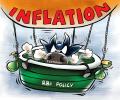
Inflation breached the upper end of the RBI's comfort level of 4 per cent plus-minus two percentage points.
The Indian economy will grow by 6.9 per cent in 2011-12 against 8.4 per cent in the last financial year according to government estimates.

The change in the baseline for IIP and WPI, currently at 2004-05, is expected to bring in more accuracy in mapping the level of economic activity and calculating other numbers like national accounts.

Advance estimates of national income growth released today by the Central Statistical Organisation (CSO) project it at 7.2 per cent in 2009-10, pegging it a notch below earlier forecasts of the Reserve Bank of India (7.5 per cent) and finance ministry (7.75 per cent). With economic growth back on track the government may initiate a phased withdrawal of the fiscal stimulus package.

India's growth slowed in three months through December from a revised 7.4% expansion in the previous quarter, but it was much stronger than expected.

According to the Central Statistical Organisation data, released earlier in the day, Index of Industrial Production grew by 16.7 per cent in January against just a per cent during the corresponding month in 2009.
The monthly income of an average Indian for the first time in the country's history has crossed Rs 3,000, thanks to economic reforms and a high growth rate of above 9 per cent achieved for three years since 2005-06.The per capita income, a measure of average income of a citizen, went up 12.2 per cent to Rs 37,490 per annum during 2008-09, said the advance estimate for national income released by the Central Statistical Organisation (CSO) on Friday.
The CSO estimate is, however, a bit lower than 7.4 per cent growth projected by the Reserve Bank for the current fiscal.

India Inc said policymakers should take doable steps to revive fixed investments and production of capital goods

The manufacturing sector during the fourth quarter recorded a growth rate of 9.3 per cent while the farm sector grew at 2.3 per cent.

The CSO said that the first revised estimates for 2016-17 have been compiled using industry-wise/institution-wise detailed information instead of using the benchmark-indicator method employed at the time of release of Provisional Estimates on May 31, 2017.

To do so, the government will have to tackle a number of broad development challenges successfully, says Shankar Acharya

India's GDP is estimated to contract by a record 7.7 per cent during 2020-21 as the COVID-19 pandemic severely hit the key manufacturing and services segments, as per government projections released on Thursday. Amid overall decline in economic activities, some respite was provided by the agriculture sector and utility services like power and gas supply, which have been projected to post positive growth during the current fiscal ending March 2021.
 © 2026 Rediff.com - Advertise with us - Disclaimer - Privacy Policy - Sitemap - Feedback - About us - Terms of use - Grievances